
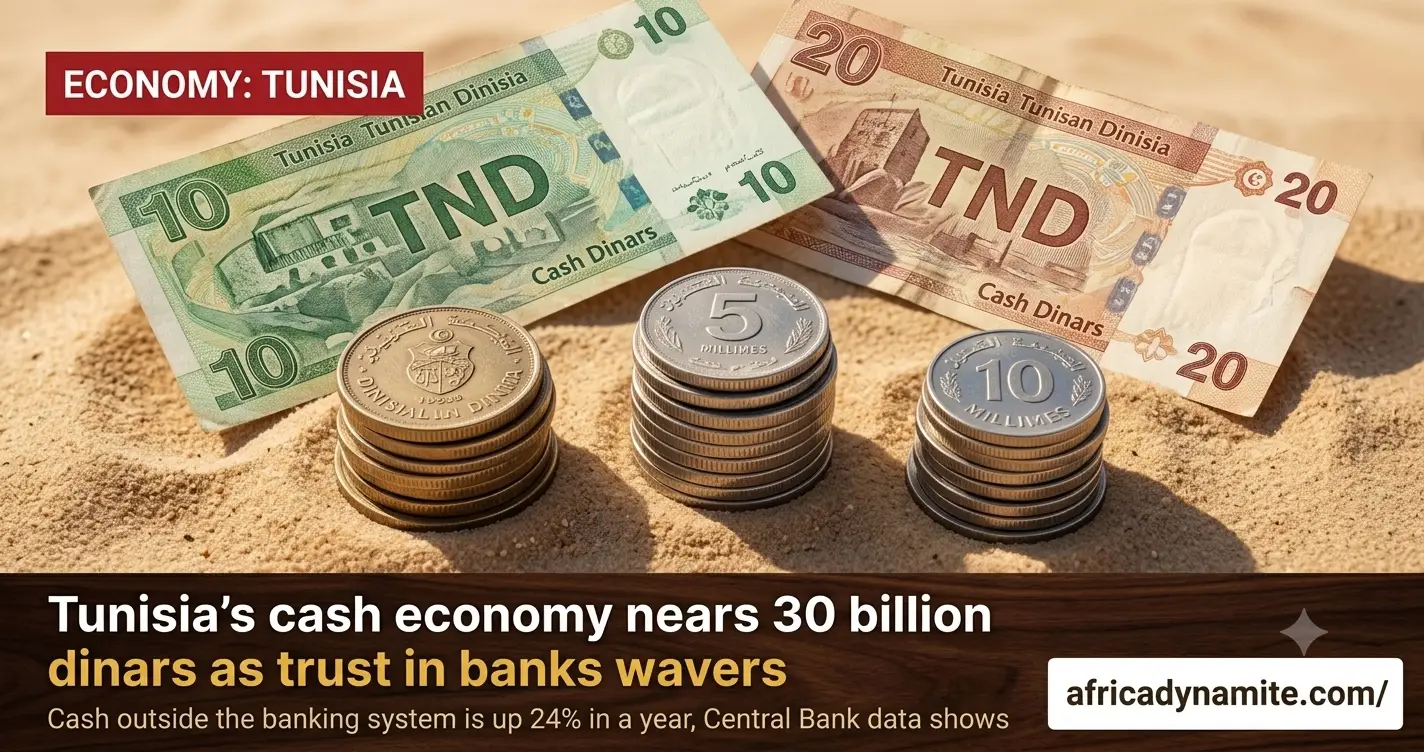
Nearly thirty billion dinars. That is how much cash the Central Bank of Tunisia now estimates is circulating outside the country’s banking system — up roughly a quarter from the year before, and still climbing. It is a number that, on its face, sounds like a technical footnote for economists. It is not. It is a running referendum, held daily in millions of small transactions, on whether ordinary Tunisians trust their financial institutions. Right now, the answer is a resounding no.
The trend has been building for years, but the pace of its recent acceleration is what should worry policymakers in Tunis. Cash in circulation has grown far faster than the broader economy, now representing well over fifteen percent of Tunisia’s entire GDP sitting physically outside bank vaults, in mattresses, cash registers, and back-pocket transactions the state cannot easily see, tax, or track.
Why Tunisians are pulling away from banks
Part of the story is regulatory. A reform of Tunisia’s check system, meant to tighten oversight and reduce fraud, has had the side effect of pushing many small businesses and individuals away from checks entirely. For years, post-dated checks functioned as an informal credit system — a way for cash-strapped shopkeepers and traders to manage timing gaps between what they owed and what they had. Tightened rules around bounced checks, backed by the threat of legal consequences, removed that informal safety valve almost overnight. The predictable result: people who used to write checks now carry cash instead.
But the deeper story is trust, and trust in Tunisia’s banking sector has been eroding for longer than any single reform can explain. Years of banking fees that eat into ordinary transactions, periodic restrictions on withdrawals and transfers, and a general sense that formal financial channels are slow, costly, and unresponsive to daily needs have pushed both households and businesses toward the one form of money that answers to no one: cash in hand. Even remittances from Tunisia’s large diaspora — a genuine economic lifeline for the country — increasingly arrive through informal channels rather than the formal banking system, as families weigh steep transfer fees against the simplicity of cash carried home in a suitcase.
The economy this creates — and the one it hides
A cash-heavy economy isn’t just an inconvenience for central bankers; it has real consequences for ordinary Tunisians and for the state’s ability to function. It fuels the informal sector, now estimated at somewhere between a quarter and a third of Tunisia’s entire economic output depending on the methodology used — a vast parallel economy operating largely beyond labor protections, tax collection, and regulatory oversight. Workers in that informal economy, disproportionately young people and women, typically have no access to pensions, health coverage tied to formal employment, or legal recourse when they’re underpaid or mistreated.
It also starves the state of revenue it badly needs. Every dinar that moves outside the banking system is a dinar the tax authorities cannot easily trace, at a moment when Tunisia’s government is already navigating a difficult fiscal position, heavy reliance on Central Bank refinancing to keep its banks liquid, and limited access to international capital markets. A shrinking traceable tax base makes every other fiscal problem harder to solve.
A crisis of policy, not just psychology
It would be a mistake to read this purely as a story about Tunisian habits or cultural preference for cash. This is a rational response to a set of real incentives: banking friction, regulatory shocks that removed informal credit tools without offering a replacement, and years of accumulated distrust that no single reform announcement is going to reverse. The Central Bank can urge Tunisians to embrace digital payments and financial inclusion all it likes; those campaigns will keep failing as long as the underlying experience of dealing with formal banks remains more costly and less reliable than the alternative.
Reversing this trend will require more than messaging. It will require making the formal financial system genuinely competitive with cash — lower fees, faster service, credible alternatives to the informal credit that post-dated checks used to provide, and a demonstrated commitment to financial inclusion for the small businesses and workers currently opting out. Until that happens, Tunisia’s cash mountain will keep growing, one quiet vote of no confidence at a time.