
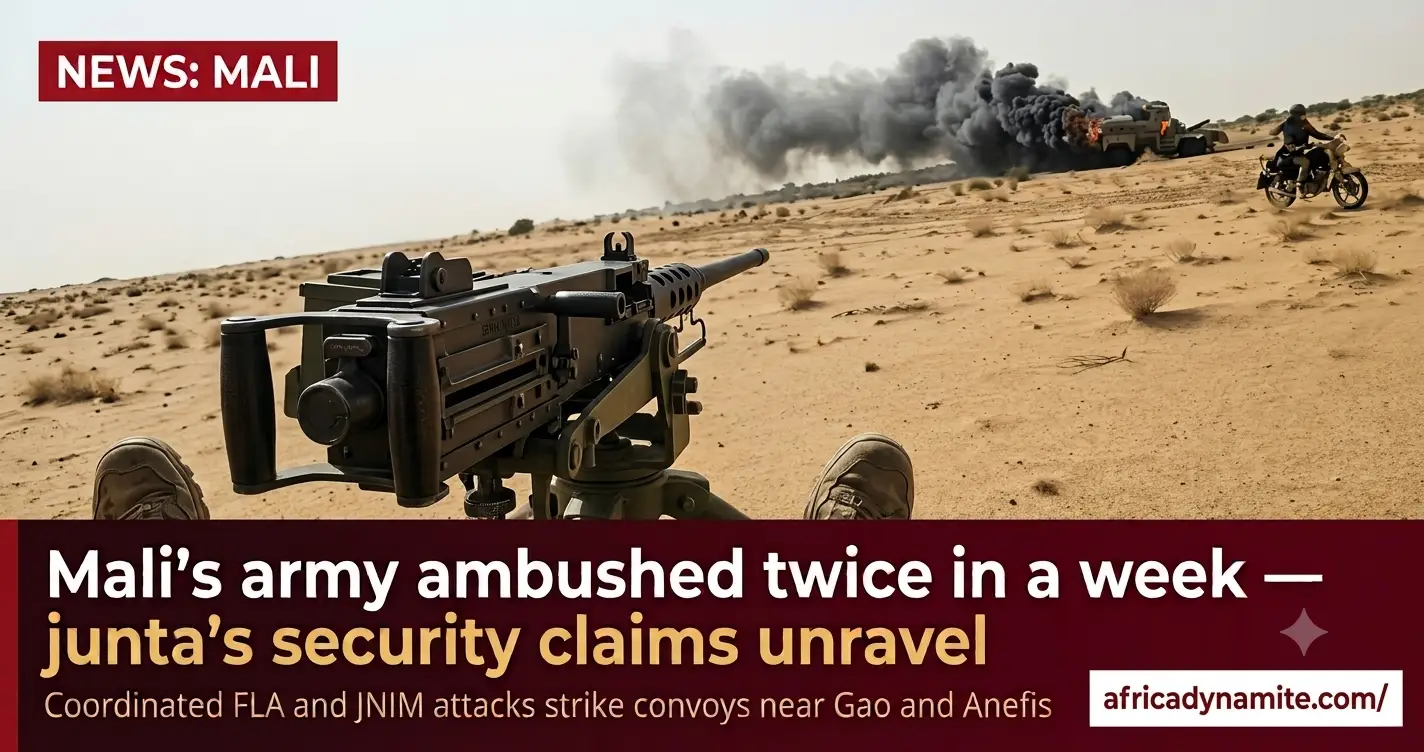
The road out of Gao has become one of the deadliest stretches of highway in the Sahel. Twice in the space of a week, military convoys moving through northern Mali were caught in ambushes so severe that the army’s own statement could only manage a terse acknowledgment: armed groups had struck, and “a counterattack is underway.” No casualty figures. No details. Just the quiet, practiced language of a government trying to control a story it can no longer control.
What actually happened is grimmer than the statement suggests. A reinforcement convoy heading toward the town of Anefis, made up largely of Malian soldiers alongside foreign mercenaries fighting under Russia’s banner, was ambushed near Tabankort. Days earlier, a separate convoy leaving Gao had already been hit. Two of Mali’s most determined enemies — the Tuareg-led Azawad Liberation Front and the al-Qaeda-linked JNIM — have increasingly stopped competing with each other and started coordinating, and the results are showing up in body counts the junta would rather not publish.
Video circulated by the rebels appeared to show captured Malian soldiers lined up in the desert, some being shot where they lay. Independent verification remains difficult, and none of the footage should be taken as gospel. But the broader picture doesn’t need footage to be believable, because it has been building for years: a military government that seized power promising security has instead watched its writ shrink, town by town, convoy by convoy, across the north.
A war the junta cannot spin its way out of
Since the 2021 coup, Mali’s ruling colonels have staked their legitimacy on one claim above all others — that where civilian governments failed to defeat the jihadists and separatists, a military government would succeed. That claim brought Wagner mercenaries, and later Russia’s Africa Corps, into the country as a substitute for the French and UN forces the junta expelled. It has not brought security. If anything, the presence of foreign fighters has given the rebels a second target and a sharper propaganda line: this is no longer just a fight against Bamako, it is a fight against a foreign occupying force propping up an unpopular government.
The tactical picture in Gao region tells its own story. Anefis was briefly seized by FLA and JNIM fighters earlier this month before being retaken. The army’s response has been to send in convoys to reinforce and resupply the town — convoys that keep getting ambushed on the same roads, in the same terrain, by fighters who evidently know exactly when and where those convoys will pass. That is not the profile of a resilient counterinsurgency. It is the profile of an army that has lost the initiative.
The human cost sits far from the headlines
Northern Mali’s civilians are the ones absorbing the consequences of a conflict neither Bamako nor the rebels seem able to finish. Transport routes into Gao and Kidal have been repeatedly disrupted by ambushes and roadblocks, driving up the price of food and fuel in towns that were already among the poorest in the country. Families in Anefis, Tabankort, and the surrounding communities live with the knowledge that any convoy passing near their homes — whether army, rebel, or humanitarian — could draw an attack.
There is also a quieter cost: trust. Malians who initially welcomed the junta’s tougher rhetoric on security have had years now to watch that rhetoric collide with reality. Coordinated ambushes, mounting casualties among “elite” reinforcement units, and a military government that answers each new disaster with a press release rather than a plan — this is not the trajectory of a state winning its war. It is the trajectory of a state that has learned to manage the optics of losing one.
What comes next
Neither the FLA nor JNIM has the strength, on its own, to topple the government in Bamako. But that was never really the test. The test is whether Mali’s junta can protect the roads that connect its northern towns to the rest of the country, resupply its own soldiers without losing them in the process, and eventually offer northern communities something better than a rotating cast of armed actors fighting over their territory. On the evidence of the past two weeks, the answer is still no — and the silence from the junta’s own statement about casualties suggests its leaders know it too.
SEO Package
Meta Title: Mali Army Convoy Ambushed Twice in a Week — Junta’s Security Claims Unravel Meta Description: Coordinated ambushes by Tuareg separatists and JNIM jihadists on Malian army convoys near Gao expose the ruling junta’s failure to deliver the security it promised. URL Slug: mali-army-convoy-ambush-gao-junta-security-failure Focus Keywords: Mali convoy ambush, Gao region attack, FLA JNIM Mali, Mali junta security, Azawad Liberation Front, Sahel conflict 2026 Secondary Keywords: Mali military junta, Wagner Africa Corps Mali, Tuareg separatists Mali, Anefis attack Schema Type: NewsArticle Article Section: African Politics & Security Social Snippet (X/Twitter): Two convoys. One week. Mali’s army keeps getting ambushed on the same northern roads — and the junta’s response is a press release. What that says about the state of the Sahel war. #Mali #Sahel #Gao Social Snippet (Facebook/LinkedIn): Mali’s ruling junta came to power promising security. Two years later, its own army convoys can’t move safely between Gao and Anefis. A look at what repeated ambushes by Tuareg rebels and jihadist fighters reveal about the state of the war in the Sahel — and who is really paying the price. Suggested Alt Text (image): Malian military vehicles on a desert road in the Gao region of northern Mali.