
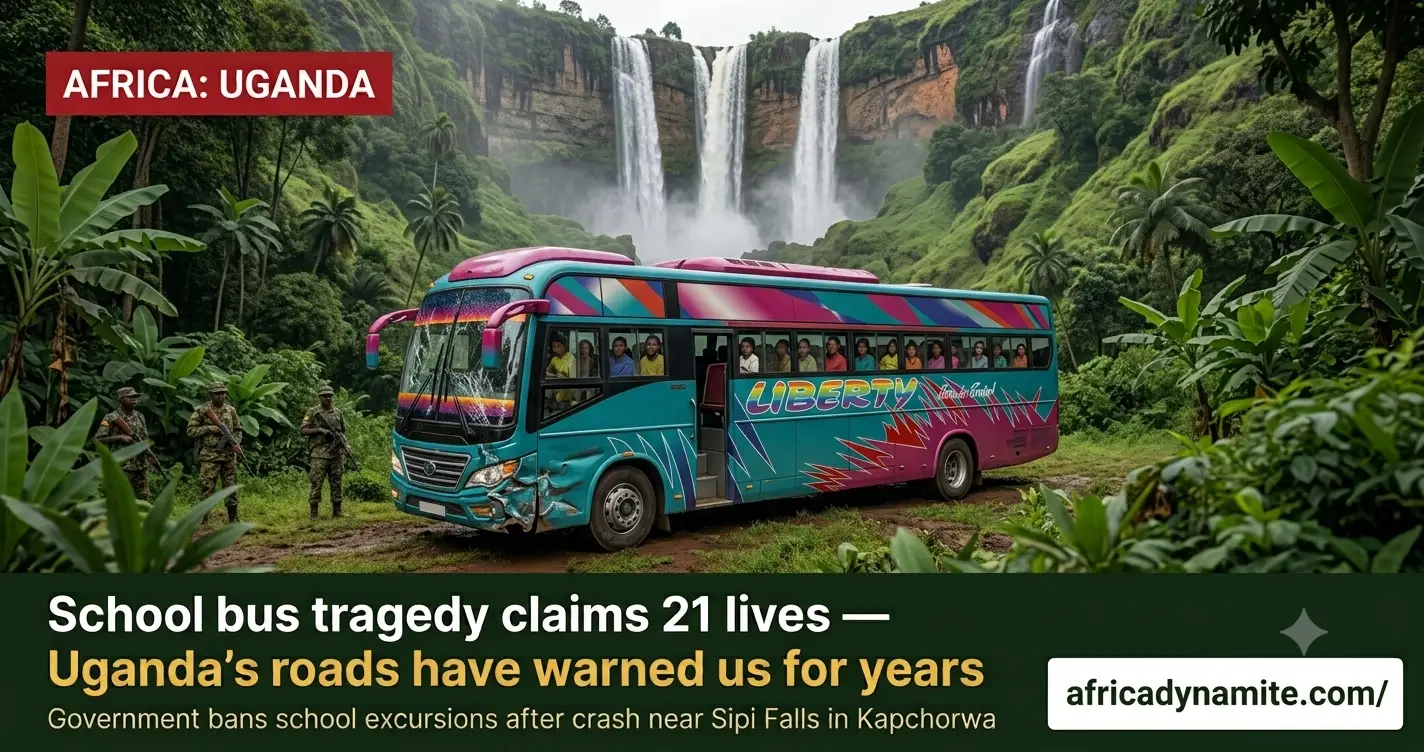
The children of King David Junior School in Kampala were on their way home from Sipi Falls, one of eastern Uganda’s most photographed natural landmarks, when their bus veered off the road in Kapchorwa district, struck a large stone, and overturned in the dark. Twenty children and one adult did not make it home. At least nine more were left in critical condition, their families now facing the kind of vigil no parent should have to keep.
Uganda’s government responded the way governments often do after a tragedy of this size: with grief, and with a ban. All school trips and excursions were suspended nationwide, effective immediately, pending review. It is a reasonable emergency measure. It is also, if history is any guide, unlikely to be the fix that actually changes Uganda’s relationship with road safety.
A pattern, not an accident
What makes this crash so hard to accept is how familiar it is. Earlier this same month, fourteen people died when a bus collided with a truck in a remote part of northern Uganda. Last October, a highway collision between the capital and the northern city of Gulu killed forty-six people. Government figures for a recent year alone recorded well over four thousand fatal road collisions and more than five thousand deaths nationwide. Uganda’s transport officials, road safety campaigners, and international bodies have said the same things for years: poorly maintained vehicles, inadequate street lighting, weak enforcement of speed limits, and roads that were never built to handle the volume and speed of traffic now moving through them.
Africa as a whole carries the world’s worst road safety burden — more than 300,000 deaths a year, at a rate several times higher than Europe’s, despite far less traffic overall. Uganda’s numbers sit uncomfortably inside that continental pattern, not outside it. This crash is not a freak accident that slipped through an otherwise functioning system. It is what a chronically under-enforced system produces, on a long enough timeline, with painful regularity.
Why a ban on school trips isn’t the whole answer
Banning excursions treats the symptom that made headlines rather than the disease that produces headlines like this every few months, regardless of what kind of trip a bus happens to be making. The driver, according to preliminary police accounts, lost control of the vehicle — a description that could just as easily apply to a commuter bus, a cargo truck, or a private minivan on any given day on Uganda’s highways. Removing school trips from the roster of risk doesn’t remove the underlying risk from the roads; it just removes children from one specific category of journey while leaving the vehicles, the drivers, the lighting, and the enforcement gaps exactly as they were.
A more durable response would mean confronting the harder, less headline-friendly questions: Are commercial buses inspected rigorously and regularly, or does that inspection regime exist mostly on paper? Are drivers trained and licensed to a standard that matches the roads they’re driving, particularly at night, on routes without adequate lighting or barriers? Is there real consequence for operators who cut corners on maintenance to save money, until the corner they cut costs twenty-one lives?
Grief, then the harder conversation
Uganda’s education minister moved quickly to suspend school trips, and the country’s Red Cross and emergency responders moved quickly to reach the crash site and get survivors to hospitals through the night. Both responses deserve credit. But the families burying children this week deserve more than an emergency policy that expires the moment public attention moves on to the next story. They deserve a government willing to treat road safety as the chronic, structural crisis the data has shown it to be for years — not a topic that gets serious attention only in the immediate aftermath of the worst possible outcome.
Uganda has been here before, more than once, in the space of a single year. The measure of whether this time is different will not be found in this week’s ban. It will be found in whether the roads, the buses, and the enforcement look any different a year from now — or whether the country is simply waiting for the next bus, on the next dark road, to remind it of what it already knows.