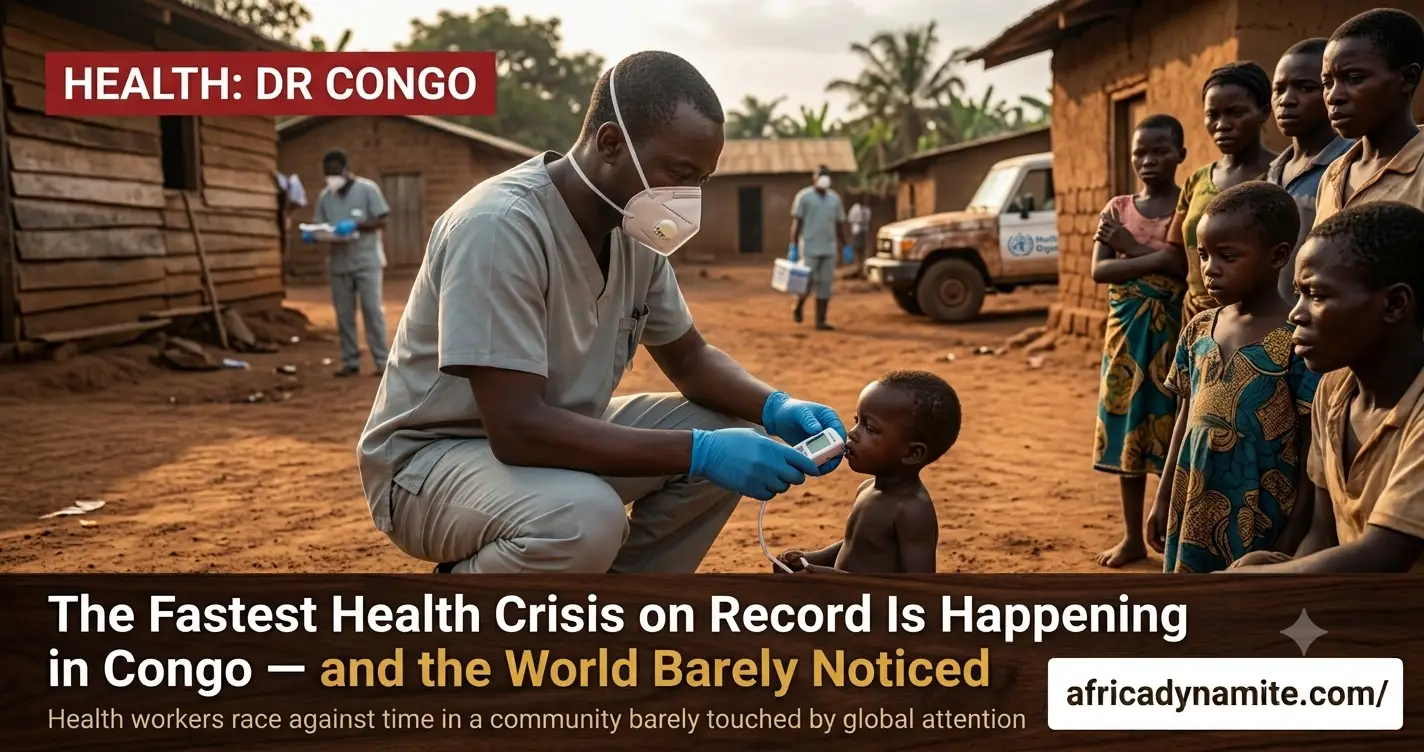
There is a particular kind of alarm in the way global health officials talk when they know they are losing ground. Not panic — health bureaucracies rarely allow themselves that — but something colder. The World Health Organization has now said out loud what the numbers had already been suggesting for weeks: the Ebola outbreak burning through the Democratic Republic of Congo is spreading faster than any Ebola outbreak the world has ever tracked.
The scale is sobering on its own terms. Confirmed cases have passed two thousand. Deaths are well above seven hundred. The outbreak, declared only in mid-May, reached that two-thousand-case mark in roughly two months — a threshold the devastating 2018–2020 North Kivu outbreak took more than ten months to cross. By any measure, that is not a slow-burning health crisis. It is a fire, and it is still spreading.
Why this outbreak keeps outrunning the response
The most alarming figure isn’t the case count — it’s the proportion of new infections that health workers cannot trace back to a known contact. Roughly eighty percent of new cases are emerging from what the WHO calls “unknown chains of transmission.” In plain terms: for every five new patients, four became infected in a way contact tracers never saw coming. That is the signature of an outbreak that has slipped past the surveillance net, spreading quietly through communities before anyone with a clipboard and a thermometer arrives.
Some of the reasons are grimly familiar to anyone who has followed Ebola outbreaks in eastern Congo before. The epicenter, Ituri province, sits in a region already destabilized by armed groups, displacement, and a fragile relationship between communities and state authority. Many of the newly reported deaths, health officials say, are people who died at home, never having reached a treatment center — a detail that speaks to both the strain on health infrastructure and the deep, earned mistrust many communities carry toward outside intervention after years of conflict and broken promises.
The virus itself is also an unusually stubborn adversary this time. The strain responsible, Bundibugyo ebolavirus, is a rarer variant for which no approved vaccine or specific treatment currently exists — unlike the more familiar Zaire strain, for which effective vaccines were deployed in previous outbreaks. Two experimental therapies only began clinical trials in early July, months into an outbreak that was already spreading explosively.
A crisis stretched across five provinces — and borders
What began in Ituri has since spread to North Kivu, South Kivu, Haut-Uele, and Tshopo, and cases linked to the outbreak have also reached neighboring Uganda, though Ugandan health authorities now say they are close to declaring their own cluster contained. That is a rare piece of good news in an otherwise grim picture, and a reminder that swift, well-resourced response can still work — when it actually gets deployed in time.
The response inside Congo itself has been undercut by a shortage of funding and, at points, strikes by frontline medical workers demanding to be paid and protected for the extraordinarily dangerous work of treating one of the world’s deadliest pathogens. It is hard to overstate how corrosive that combination is: an outbreak accelerating in real time, met by a health workforce that cannot be confident it will be compensated or kept safe for showing up.
Why African governance, not just global charity, is the real test here
It’s easy, and not entirely wrong, to frame this as a story about global indifference — an outbreak that would dominate front pages for weeks if it were unfolding in Europe or North America instead of eastern Congo. But that framing lets African institutions off the hook too easily. The DRC has now managed seventeen Ebola outbreaks. Each one is both a public health emergency and a test of whether the state can mobilize resources, protect its health workers, and earn the trust of communities faster than the virus can exploit the gaps. This outbreak, so far, is a test the system is failing — not for lack of medical knowledge, but for lack of the funding, protection, and trust that turn medical knowledge into contained transmission chains.
The WHO’s own language — “this is not a burden DRC can be allowed to carry alone” — is true, and it should be repeated loudly to donor governments who have quietly deprioritized health emergencies that don’t threaten their own borders. But it is equally true that DRC’s own government, and the wider African Union and Africa CDC apparatus, need to treat this outbreak with the urgency its case-growth curve demands, rather than waiting for the rest of the world to notice first.