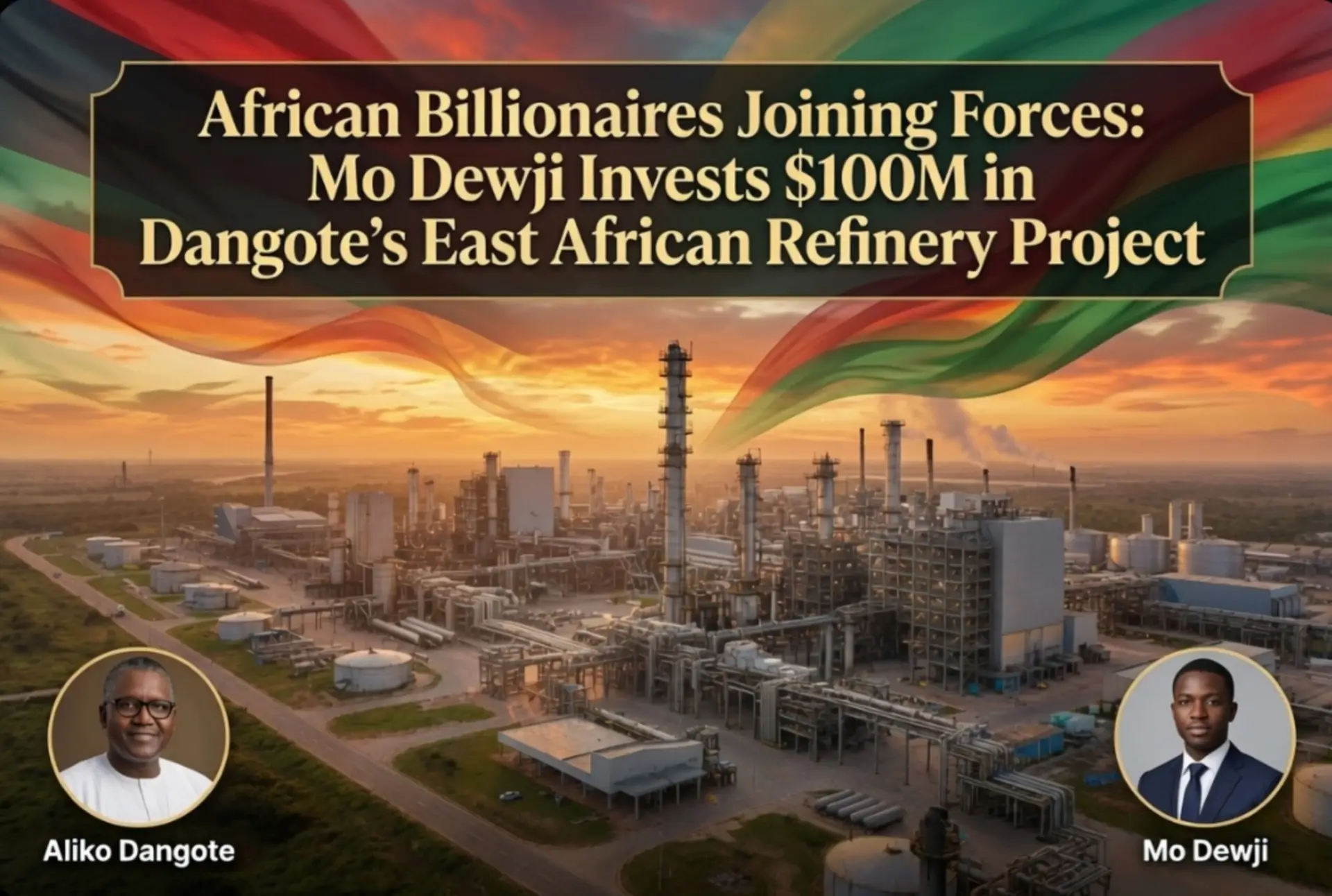
There is an easy narrative being told right now, which can be simplified in the following way: two of Africa’s richest individuals are partnering together, a $17 billion refinery will be constructed in East Africa, and Africa is finally beginning to learn how to invest in itself. It’s a good story. It’s also incomplete, and incomplete stories about African megaprojects have a way of aging badly.
Here’s what actually happened. Mohammed “Mo” Dewji, Tanzania’s richest man and the only Tanzanian on Forbes’ 2025 billionaires list, told Bloomberg this week that he’s ready to put $100 million into Aliko Dangote’s planned East African refinery. Dangote — Africa’s richest man, fresh off building the continent’s largest single-train refinery outside Lagos — has already picked his site: Lamu, a coastal town in Kenya, not Tanzania. Dewji, notably, wanted it built at home. “I would lean more toward Tanzania than Kenya,” he said, before adding that he’d invest regardless of where it lands. The two men, by Dewji’s own account, haven’t even had the conversation yet. He’s reaching out. This is a pledge of interest, not a signed term sheet.
None of that makes the story meaningless. But it changes what kind of story it is.
The Track Record That Makes This Credible — and the One That Should Make Us Cautious
Dangote’s Lagos refinery is a genuine achievement — 650,000 barrels a day now, with plans to push toward 1.4 million by 2028, making it one of the largest refining complexes on earth. That’s the proof of delivery analysts point to when they say his word carries weight with investors in a way that a greenfield promise from anyone else wouldn’t.
But here’s the part of the Lagos story that tends to get left out of the celebratory retelling: that refinery was originally priced at $9 billion. It ended up costing more than $20 billion, dragged out by construction delays, currency depreciation, a global pandemic, and inflation that ate through every early projection. If the Lamu refinery — currently estimated at $17 billion — follows anything like that same trajectory, we’re not talking about a five-year, $17 billion project. We’re talking about a project that could take longer and cost dramatically more, financed in part through bond issuances and an IPO that hasn’t happened yet.
This matters because the entire pitch for these mega-refineries rests on a promise: that Africa can stop exporting raw crude and importing back the refined fuel at a markup, and instead capture that value at home. It’s a sound argument — Dewji himself put it plainly, saying the continent can’t keep depending on imports and needs to refine and manufacture to become sovereign over its own resources. I don’t disagree with the diagnosis. I’m skeptical of how cleanly the execution tends to match the ambition.
The Diaspora and Local Capital Question Nobody’s Asking Loudly Enough
What actually excites me about this story isn’t the headline dollar figure. It’s the precedent. If Dewji’s $100 million materializes into an actual signed stake, it will be one of the more visible examples in recent memory of African capital funding African industrial infrastructure, at scale, without a Western development bank or multilateral lender as the primary sponsor. Compare that to how most large African energy and infrastructure projects still get financed — through the World Bank, through Chinese state lenders, through European export credit agencies — and you start to see why this deserves more attention than a passing business-page mention.
But intra-African capital flowing into intra-African infrastructure only becomes a real trend if it happens more than once, and if the terms are transparent. Kenya’s government will need to explain what it offered Dangote to win the site over Tanzania — tax incentives, land concessions, guaranteed offtake agreements — because “commercial and technical reasons,” Dangote’s own vague explanation for choosing Lamu, tells Kenyan and Tanzanian citizens almost nothing about what their governments actually negotiated on their behalf.
And that’s really the accountability gap sitting underneath this entire story. We’re several days into breathless coverage of a $100 million pledge and a $17 billion refinery, and almost none of the reporting has asked the questions East African civil society should be asking right now: What environmental review has Lamu — an island with its own fragile ecosystem and a UNESCO World Heritage old town nearby — actually undergone? What labor and local-content commitments has Dangote Group made to Kenyan workers and Kenyan suppliers, as opposed to importing its own construction workforce and equipment, as has happened on other continental megaprojects? Who benefits if the refinery’s timeline slips the way Lagos’s did, and who absorbs the cost?
Cooperation over Competition Is the Right Instinct — If It’s Followed Through
There’s something genuinely worth admiring in Dewji’s posture here. He wanted the refinery in his own country and lost that fight, and instead of walking away, he’s choosing to invest in a neighbor’s win because he sees the regional upside — lower fuel costs, thousands of jobs, reduced dependence on imported refined products across Kenya, Tanzania, Uganda, and beyond. That’s a more mature form of pan-Africanism than the rhetorical kind we’re used to hearing at conferences. It’s capital following a stated belief that African prosperity isn’t zero-sum between neighboring states.
But admiration for the instinct shouldn’t turn into a free pass on scrutiny for the execution. Africa has watched too many megaprojects get announced with fanfare, financed with imported debt, delayed for years, and completed at two or three times their original budget — with local communities absorbing the environmental cost and seeing the smallest share of the promised jobs. Lagos itself is proof of that pattern, even as it’s also proof that Dangote can eventually deliver.
So yes — celebrate the fact that two African billionaires are willing to bet nine and ten figures on African industrial capacity instead of parking that money in London property or Swiss accounts. That’s genuinely worth noting. But the job of the press covering this story isn’t to simply repeat the optimism back to readers. It’s to keep asking, twelve months from now and thirty-six months from now, whether the Lamu refinery is actually being built on the terms East Africans were promised — or whether it’s quietly becoming another chapter in the long story of African megaprojects that cost more, took longer, and delivered less to ordinary citizens than the press conference suggested.