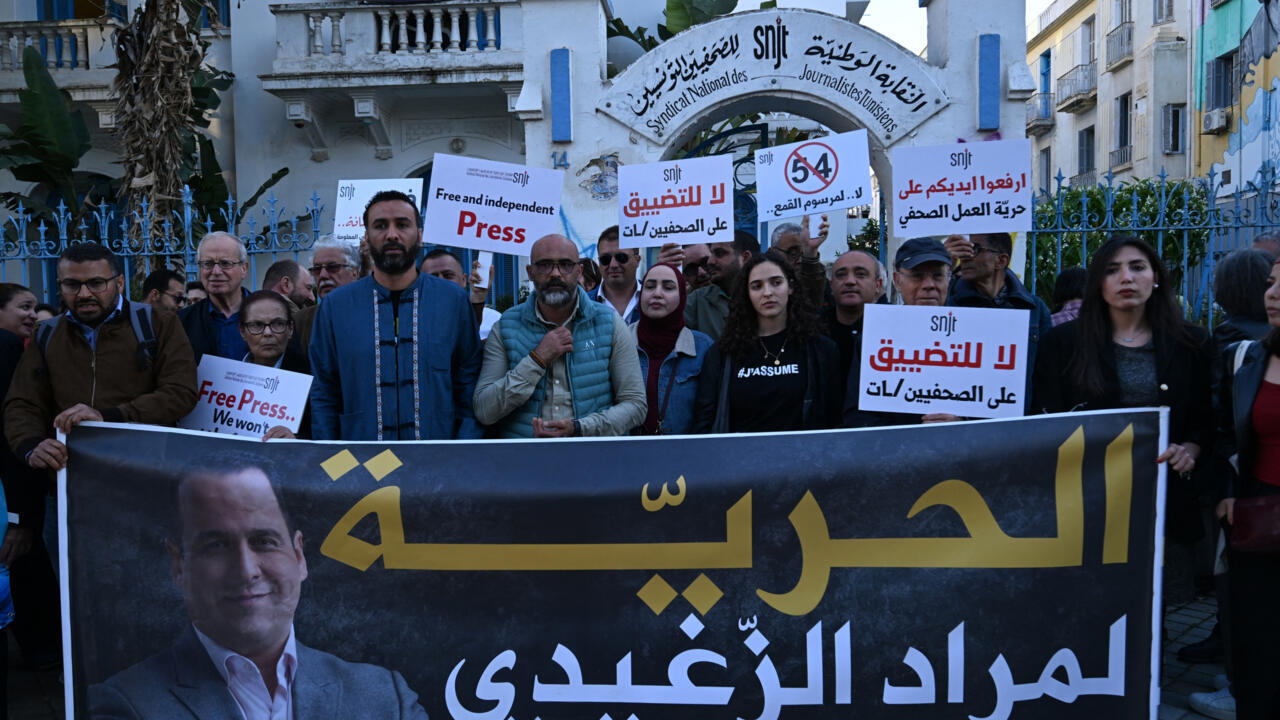
On Friday, Tunisian journalist Zied Heni was arrested after publishing an article criticising the country’s judiciary. No charge has been publicly stated, and the prosecutor’s office has said nothing. What has been said — loudly — is that this is not a one-off. The head of Tunisia’s journalists’ union called it “arbitrary” and part of a deliberate effort to silence the last independent voices in the country.
To understand why that matters, you have to understand who Zied Heni is, and how far Tunisia has fallen from the promise it once held.
A Journalist Who Has Been Here Before
Heni is not an obscure blogger or a fringe commentator. He is one of Tunisia’s most recognised media figures — a radio presenter and political commentator with a long history of holding the powerful to account. He co-founded the National Syndicate of Tunisian Journalists, the very organisation now condemning his arrest. He is widely credited with popularising the phrase “Jasmine Revolution” to describe the 2011 uprising that toppled dictator Zine El Abidine Ben Ali and sent a shockwave of hope across the Arab world.
This is also not his first run-in with the current authorities. In June 2023, plainclothes security officers entered his home in a Tunis suburb and detained him after a judge ordered he be held ahead of trial on charges of insulting President Kais Saied. In December 2023, he was arrested again — this time after criticising the Minister of Commerce on air. A court later sentenced him to a six-month suspended prison sentence for that episode. Now, in April 2026, he is in custody again. The charge, to the extent one exists, appears to be writing something the government did not like.
The Bigger Picture: What Has Happened to Tunisia
For a moment in 2011, Tunisia felt like proof that something different was possible. After Ben Ali fled the country, Tunisia became the Arab Spring’s one genuine democratic success story. Press freedom flourished. Civil society grew. Newspapers and radio stations that would have been shut down overnight under the old regime were openly critical of whoever held power.
That window has been closing since 2021, when President Kais Saied dissolved the elected parliament and began ruling by decree. In 2022, he dissolved the Supreme Judicial Council and dismissed dozens of judges — a move critics said turned the courts into instruments of political control. Saied insists he cleaned up a corrupt judiciary and that the courts are now independent. Few independent observers agree.
Since then, the pattern has been consistent. Opposition party leaders have been jailed. Activists, lawyers, businesspeople and journalists have been prosecuted on charges ranging from conspiring against state security to money laundering and spreading fake news. Human Rights Watch reported that by late 2024, more than 80 people were being held on political grounds or for exercising basic rights. International press freedom groups have watched Tunisia slide steadily down their rankings.
Heni’s case fits this pattern precisely. He wrote something critical of the judiciary. He was arrested. No charge has been announced.
The Law Being Used Against Journalists
Much of this crackdown runs through Decree Law 54, a cybercrime law Saied introduced in 2022 that Amnesty International described as draconian. It gives authorities sweeping powers to pursue anyone deemed to have spread “false news” or “insulted” public officials — offences with definitions broad enough to cover almost any criticism. Journalists, lawyers and social media users have all been caught in its net.
Heni has faced charges under this law before. In the December 2023 case, the court used it to charge him with “insulting others on social media.” Amnesty called his detention arbitrary and pointed out that “insulting” officials is not a recognised offence under international law.
The Committee to Protect Journalists, which has been tracking his cases closely, put it plainly at the time: arresting a journalist for political commentary on the radio is “simply cruel.”
What the Journalists’ Union Is Saying
Zied Dabbar, head of the Tunisian journalists’ union, described this week’s arrest as “arbitrary” — a word that carries weight when the person using it runs the organisation Heni helped to build. Dabbar said it was another deliberate step aimed at intimidating journalists who have not yet fallen silent.
That framing — intimidation as a goal, not a byproduct — is echoed by international bodies. The International Federation of Journalists has written directly to President Saied asking him to use his powers to protect press freedom. The response from the presidency has been consistent: Saied says freedoms are guaranteed in Tunisia, and that no one is above the law regardless of their name or position.
The difficulty with that argument, critics say, is that the law is being selectively applied. Journalists who challenge the government go to prison. Officials who silence journalists do not.
Why This Matters Beyond Tunisia
Tunisia’s deterioration matters for reasons that go beyond its own borders. It was supposed to be the exception — the country that showed the Arab Spring could produce lasting democratic change. If it can happen there, the argument went, it can happen anywhere.
That argument now runs in reverse. If the gains made in 2011 can be dismantled within a decade, if a president can dissolve parliament, reshape the courts, and systematically jail his critics without losing international support, then the lesson is a darker one.
Zied Heni wrote something critical of the judiciary. He is in prison. The prosecutor has not explained why. His lawyer is fighting for his release. The journalists’ union is calling it what it is.
The question now is whether anyone outside Tunisia is paying attention.