The Nigeria Morocco gas pipeline cleared its biggest political hurdle yet on July 19, when heads of state from the Economic Community of West African States gathered in Freetown, Sierra Leone, to sign the Intergovernmental Agreement governing what is formally called the African Atlantic Gas Pipeline. The ceremony was, by every account, a triumphant affair. Regional integration. Energy security. A “project for present and future generations,” in the words of Morocco’s King Mohammed VI, whose office confirmed the signing as a milestone toward realizing an initiative he launched alongside Nigeria a decade ago.
Africa Dynamite is not going to pretend the Nigeria Morocco gas pipeline has no merit. A corridor connecting Nigeria’s gas reserves to thirteen coastal nations, with the stated aim of expanding domestic electricity access along the way, addresses a genuine and long-standing failure of African infrastructure. But before this gets filed away as an unambiguous continental win, someone needs to ask the question that got buried under the applause in Freetown: who is the Nigeria Morocco gas pipeline actually built for, and who bears the risk if the answer isn’t West Africa?
Truth #1: Half the Gas Bypasses West Africa Entirely
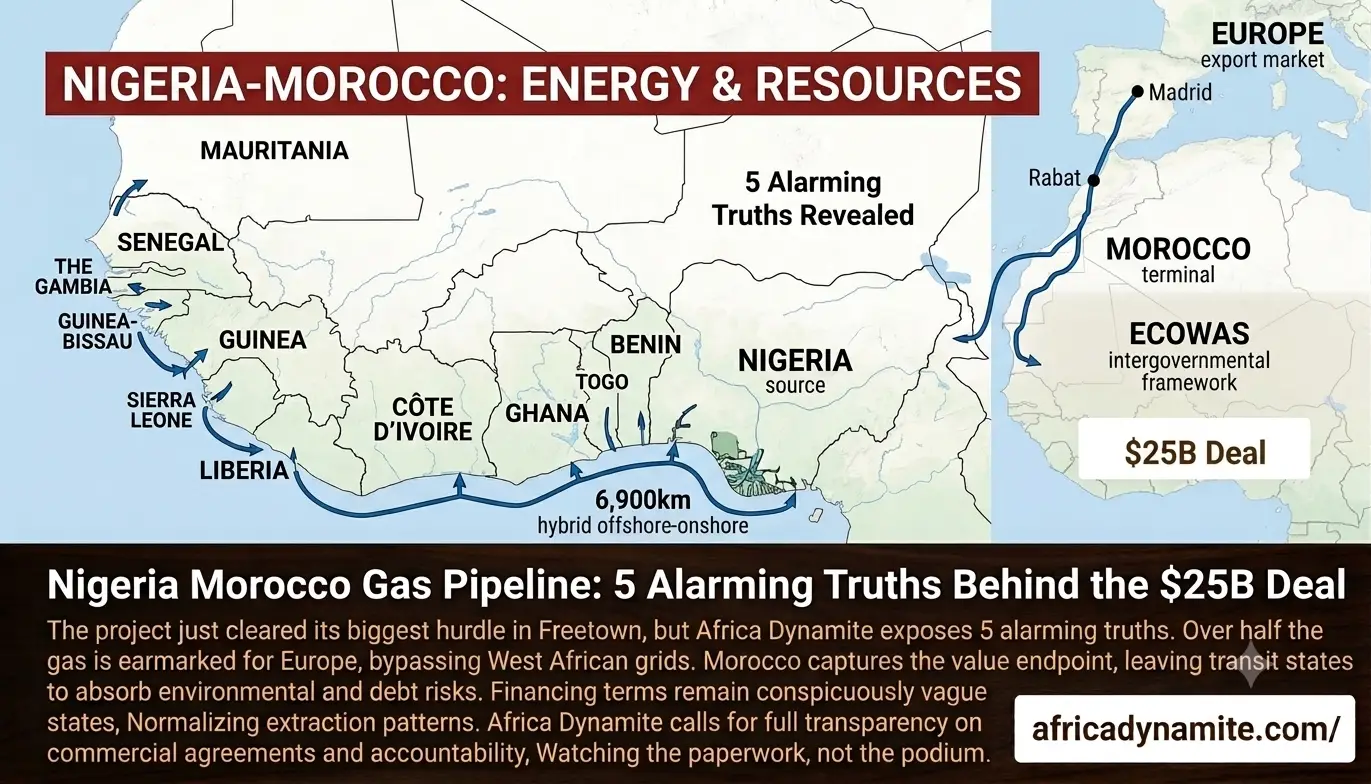
The project will carry an estimated 30 billion cubic meters of natural gas annually once complete, according to the official joint statement from ECOWAS covering the signing. Roughly half of that — 15 billion cubic meters — is designated for export to Morocco and onward to European markets. That means the single largest declared purpose of the Nigeria Morocco gas pipeline, built substantially with Nigerian gas, is to supply Europe’s energy needs, not West Africa’s own grid.
The remainder is meant to serve “participating West African countries,” a phrase vague enough to mean almost anything, and specific enough to mean nothing has actually been guaranteed to any single nation along the route.
Truth #2: Morocco Captures the Value, West Africa Absorbs the Risk
This is not a minor technical detail. It is the entire architecture of the deal. Europe has spent the past several years scrambling to diversify away from Russian gas, and North Africa has become an obvious answer to that scramble. Morocco, sitting at the pipeline’s terminus with a direct connection into the European grid, occupies the most commercially valuable position in this entire thirteen-country chain. Nigeria supplies the raw resource, through its state oil firm NNPC working alongside Morocco’s ONHYM. West African transit states absorb the environmental and logistical burden of a roughly 6,900-kilometer hybrid offshore-onshore pipeline crossing their territory. The value-added endpoint — where the gas actually becomes leverage, revenue, and geopolitical weight — sits in Rabat and, ultimately, in Brussels and Madrid.
Africans have seen this shape before. It is the shape of extraction economies going back a century: raw material moves outward, processed value and strategic advantage accumulate elsewhere, and the resource-producing country is left managing the disruption, the debt, and the environmental cost while celebrating a “milestone” it did not structure the terms of.
Truth #3: The Financing Terms Remain Conspicuously Vague
Reporting on the Freetown summit, including from Forbes Africa, confirms the intergovernmental agreement now moves the Nigeria Morocco gas pipeline into its institutional and financial phase — but stops short of naming hard financial commitments for a project now priced at $25 billion. Construction is not slated to begin until after the project company, headquartered in Casablanca, and the Pipeline Higher Authority in Abuja are fully established.
That gap matters enormously. Africa’s infrastructure history is littered with megaprojects signed with fanfare and then quietly restructured once the real financing terms came due — restructured in ways that shifted debt onto the public balance sheets of the poorest countries in the chain while insulating wealthier partners and private financiers. Thirteen countries are nominally part of this pipeline. Several of them — Guinea-Bissau, Liberia, Sierra Leone, The Gambia — rank among the world’s most debt-vulnerable states. If the pipeline’s financing structure eventually requires sovereign guarantees, loan exposure, or land and rights-of-way concessions from these governments, the public deserves to know that now, not after the terms are locked.
Truth #4: A Decade of Delay Should Breed Skepticism, Not Celebration
It is worth remembering the Nigeria Morocco gas pipeline was first proposed in 2016, under King Mohammed VI and then-President Muhammadu Buhari. It has taken nearly a decade to move from concept to a signed intergovernmental framework, and construction itself remains years away even under the current timeline. Megaprojects of this scale routinely slip further. The gap between “agreement signed” and “gas flowing” has, across the history of African cross-border infrastructure, frequently been measured in additional years or decades, not months.
None of that is disqualifying on its own. Big infrastructure takes time everywhere. But it should temper the celebratory framing dominating current coverage. What was signed in Freetown is a legal and regulatory framework — an important step, genuinely — not a completed pipeline, not a guaranteed revenue stream for transit states, and not yet a demonstrated commitment to prioritizing West African electrification over European export volume.
Truth #5: Oversight Bodies Aren’t the Same as Accountability
The creation of the Pipeline Higher Authority in Abuja to coordinate investor outreach is a step toward transparency in principle. Whether it functions as genuine oversight or as a diplomatic formality that rubber-stamps decisions made elsewhere remains to be seen. West Africans should be asking for the underlying commercial agreements behind the Nigeria Morocco gas pipeline — not just the intergovernmental framework — to be made public well before construction begins.
If this project is to be the “project for present and future generations” its boosters claim, the burden of proof sits with the governments who signed it, not with the citizens being asked to trust the process. That means publishing the actual commercial terms. It means clarity on how much of the 15 billion cubic meters allocated to non-export use will genuinely reach underserved communities in transit countries, with binding delivery targets rather than aspirational language. It means West African governments negotiating collectively, rather than allowing Morocco and Nigeria to set terms that thirteen other nations are simply invited to ratify.
(Related on Africa Dynamite: our coverage of Germany’s security pledge to Nigeria explores a similar pattern — big diplomatic announcements that outrun the funding behind them.)
The Bottom Line
Africa does not lack resources. It has never lacked resources. What it has repeatedly lacked is the negotiating discipline to ensure those resources build wealth at home before they build wealth abroad. Every future headline about the Nigeria Morocco gas pipeline should be measured against that standard. The Nigeria Morocco gas pipeline could genuinely be different. But that will be proven in contracts, disbursement records, and electrification numbers over the next decade — not in a signing ceremony in Freetown, and not in a king’s speech about future generations. Africa Dynamite will be watching the paperwork, not the podium.
Africa Dynamite covers African governance, resource accountability, and cross-border infrastructure with an unflinching eye. Follow us for continued coverage of the Nigeria Morocco gas pipeline as financing and construction details emerge.