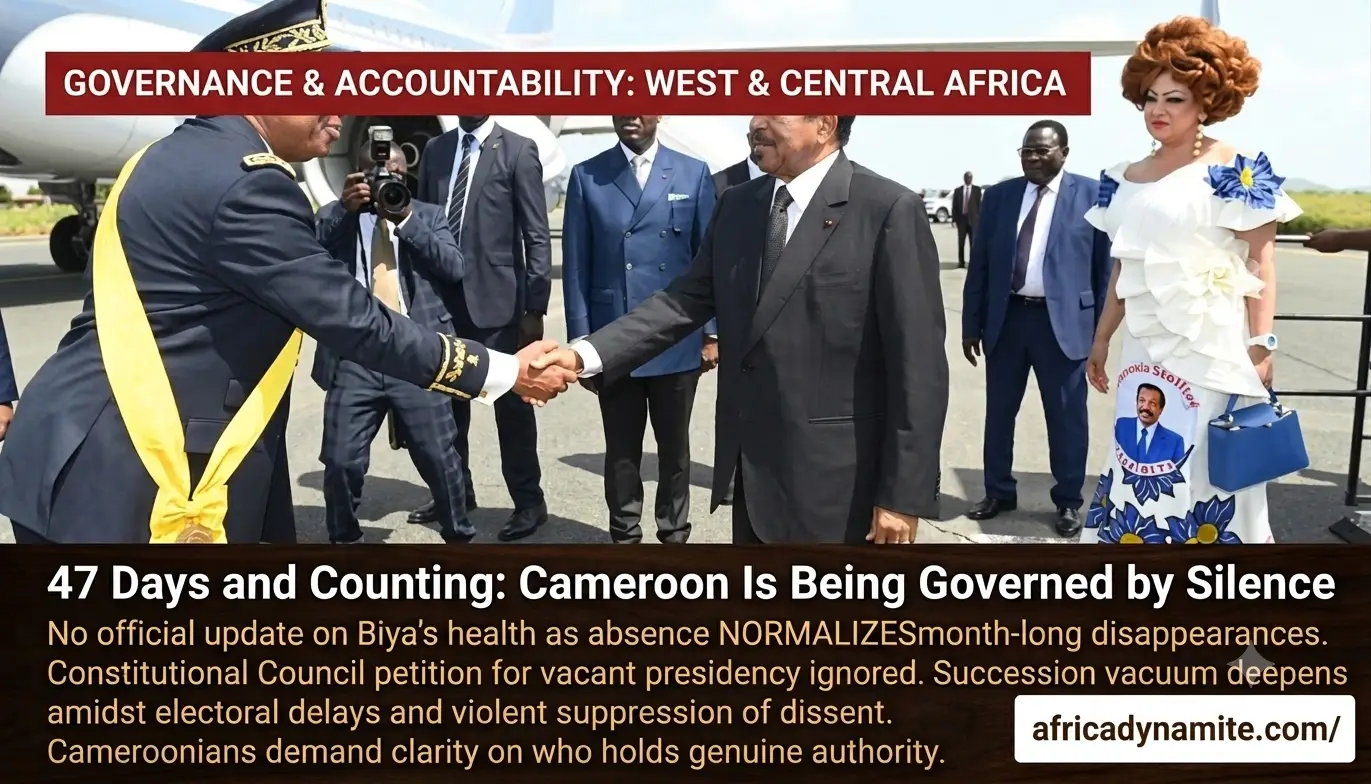
There is a number that should stop any Cameroonian in their tracks: 47. That is how many days President Paul Biya, 93 years old and the world’s oldest sitting head of state, has now spent outside his own country, with no public explanation beyond a vague reference to “a brief private stay in Europe” and no indication from his government of when — or whether — he intends to return. He left Yaoundé on June 7. Since then, Cameroon’s ruling party has convened emergency leadership meetings, opposition figures have petitioned the Constitutional Council to declare the presidency vacant, and the government has spent more energy denying hospitalization rumors than governing the country Biya was re-elected, under deeply contested circumstances, to lead.
The opposition Social Democratic Front has a blunt phrase for what this looks like: the country is running “on autopilot.” It is difficult, examining the available facts, to argue they are wrong.
This Is Not New. That Is the Point.
Biya’s current absence is not an aberration. It is a pattern with a track record. In late 2024, he spent roughly 50 days outside Cameroon under similarly opaque circumstances, and the government’s response then — banning public discussion of his health — set the template for how this administration handles questions about its own leader’s whereabouts and fitness to govern. What should alarm Cameroonians is not simply that Biya is absent again. It is that a 43-year-old presidency has normalized month-long disappearances as a routine feature of governance, to the point where the real news is not that he left, but that this time he has stayed away even longer than before.
Consider what has not happened during these 47 days. Biya’s own December 31 address promised a new government “in the coming days.” Seven months later, no cabinet reshuffle has materialized. Municipal and legislative elections, already delayed multiple times, remain indefinitely postponed, quietly extending the tenure of officials whose mandates have technically expired. These are not new crises created by the current absence — they are pre-existing failures of accountability that a genuinely present, functioning executive would be expected to resolve, and that an absent one has every incentive to let drift.
The Health Question Cameroon’s Government Won’t Answer Honestly
Reports that Biya was receiving care at a private clinic in Geneva, tied to a reported health incident during Cameroon’s National Day events in May, were met with a swift denial from Communication Minister René Emmanuel Sadi, who called the reporting “malicious and unfounded.” A senior ruling-party official went further, insisting the presidency was not vacant because, in his framing, the Lion had not left. Higher Education Minister Jacques Fame Ndongo offered the now-standard reassurance that Biya remains in control and is closely following official files from wherever he happens to be.
None of these denials are backed by anything Cameroonians can independently verify. No medical statement. No proof-of-life appearance beyond social media posts congratulating foreign leaders on national holidays — posts that confirm someone is managing Biya’s accounts, not that Biya himself is exercising the judgment and authority his office requires. When a 93-year-old head of state disappears from public view for a month and a half and the most concrete evidence of his continued engagement is a congratulatory message to Montenegro’s president, the government’s insistence that everything is normal asks for a level of trust it has done nothing to earn.
What the Constitution Says, and Why Nobody Is Invoking It
Cameroon’s constitution is not silent on this scenario. If the presidency becomes genuinely vacant, the president of the Senate is designated to serve as interim head of state, with a new presidential election required within 120 days. That mechanism exists precisely for moments like this one — extended absence, health uncertainty, an aging leader whose capacity to govern is in legitimate public doubt. And yet the ruling Cameroon People’s Democratic Movement has spent its emergency meetings this week discussing an undisclosed “important working session” rather than triggering, or even seriously debating, the constitutional process designed for exactly this circumstance.
That refusal is itself the story. A functioning democracy with genuine institutional accountability does not require a president’s physical return to resolve basic questions about who holds authority and why. Cameroon’s ruling elite has instead chosen ambiguity over clarity, apparently calculating that an unresolved vacuum serves entrenched interests better than an honest reckoning with succession. Given that Biya’s October re-election to an eighth term was itself disputed by the opposition, triggered demonstrations violently suppressed with dozens of confirmed deaths, and was received with open reservations by some Western embassies, the incentive for the ruling party to avoid a clean constitutional process is not hard to identify.
Autopilot Is a Choice, Not an Accident
Describing Cameroon as “on autopilot” risks making the situation sound accidental — as though the country has simply been left unattended by circumstance. It has not. Forty-seven days of unexplained absence, a decades-long pattern of similar disappearances, a government machine practiced at denial rather than disclosure, and a ruling party unwilling to invoke its own constitution’s remedy for exactly this scenario — none of that is drift. It is the predictable output of a political system built around the indefinite preservation of one man’s authority, regardless of his actual capacity to exercise it.
Cameroonians deserve more than reassurances relayed through party officials and social media posts written on someone else’s behalf. They deserve a government that can say, plainly, where their president is, what his condition actually is, and when — or under what constitutional process — the country will have clarity about who is genuinely in charge. Forty-seven days of silence is not leadership. It is the absence of it, dressed up in the language of “meticulous” attention from afar.
Africa Dynamite covers African governance, accountability, and presidential power with an unflinching eye. Follow us for continued coverage as developments in Yaoundé unfold.