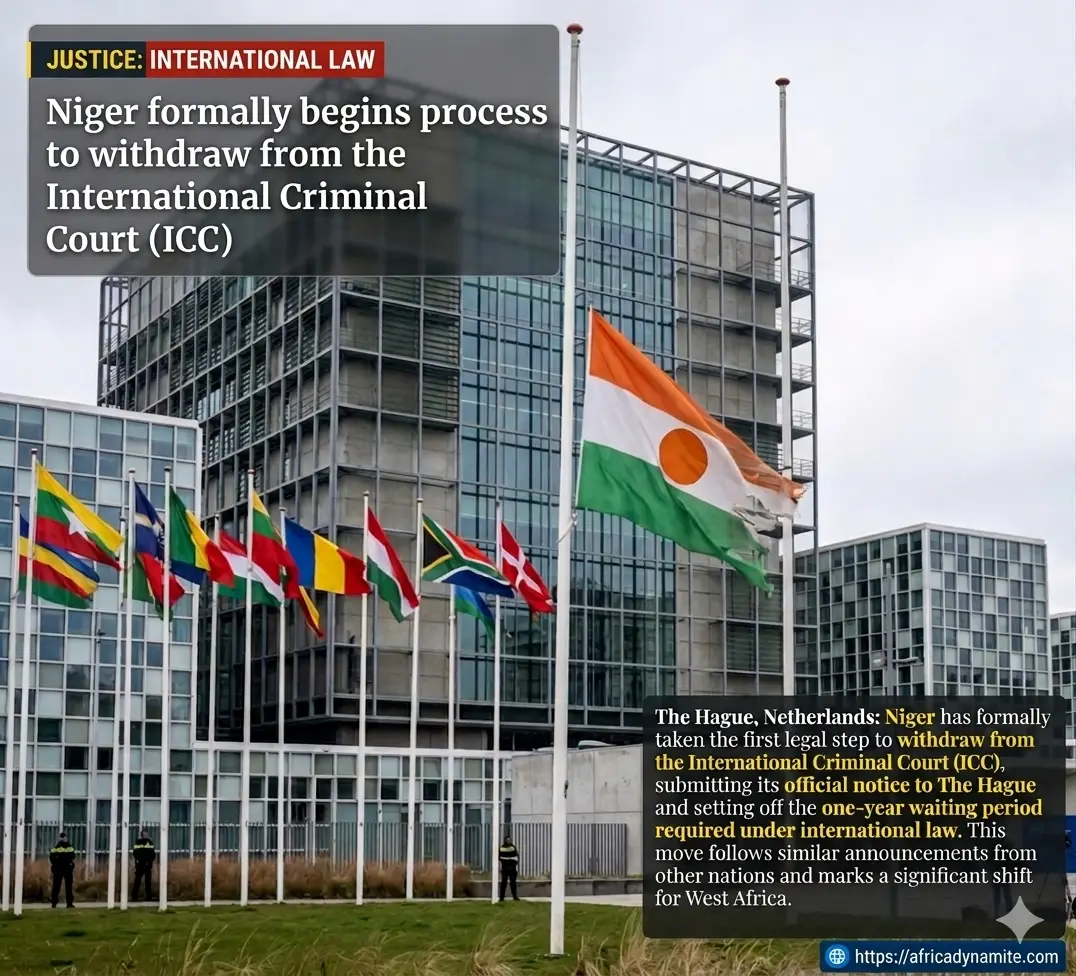
Niger has formally taken the first legal step to withdraw from the International Criminal Court (ICC), submitting its official notice to The Hague and setting off the one‑year waiting period required under international law.
Government officials confirmed that the withdrawal document was delivered earlier this month, meaning Niger’s exit will become legally effective in June 2027, unless the decision is reversed before then. Until that date, the country remains fully bound by all ICC obligations.
A Strategic Break From International Institutions
The decision reflects a broader political shift in the Sahel, where Niger, Mali, and Burkina Faso—each governed by military-led administrations—have increasingly distanced themselves from Western-backed organizations.
All three countries have criticized the ICC for what they describe as uneven justice and a pattern of disproportionately targeting African nations.
Niger first signaled its intention to leave the court in 2025, arguing that the ICC no longer aligns with its national interests or its vision of sovereignty.
ICC Responds With Concern
The ICC acknowledged receiving Niger’s withdrawal notice and expressed regret over the decision. The court emphasized that global cooperation remains essential to prosecuting war crimes, crimes against humanity, and genocide.
Importantly, the ICC clarified that it retains jurisdiction over any crimes committed before the withdrawal becomes official, meaning ongoing or potential investigations involving Niger remain unaffected for now.
A Region Redefining Its Alliances
Niger’s move is part of a deeper realignment in the Sahel. The country has strengthened its partnership with Mali and Burkina Faso through the Confederation of Sahel States, a political and military bloc formed after all three nations broke away from traditional Western alliances.
The region continues to face severe security challenges, including insurgencies linked to Al‑Qaeda and ISIS affiliates. Human rights groups have also raised concerns about abuses committed during counter‑terrorism operations—issues the ICC has monitored closely in recent years.
What Happens Next
If Niger completes the withdrawal process, it will become only the third country in history to leave the ICC, following Burundi and the Philippines.
Analysts warn that the move could weaken international accountability mechanisms in a region already struggling with instability and humanitarian crises.
For now, Niger remains a full ICC member until the withdrawal becomes legally binding next year.