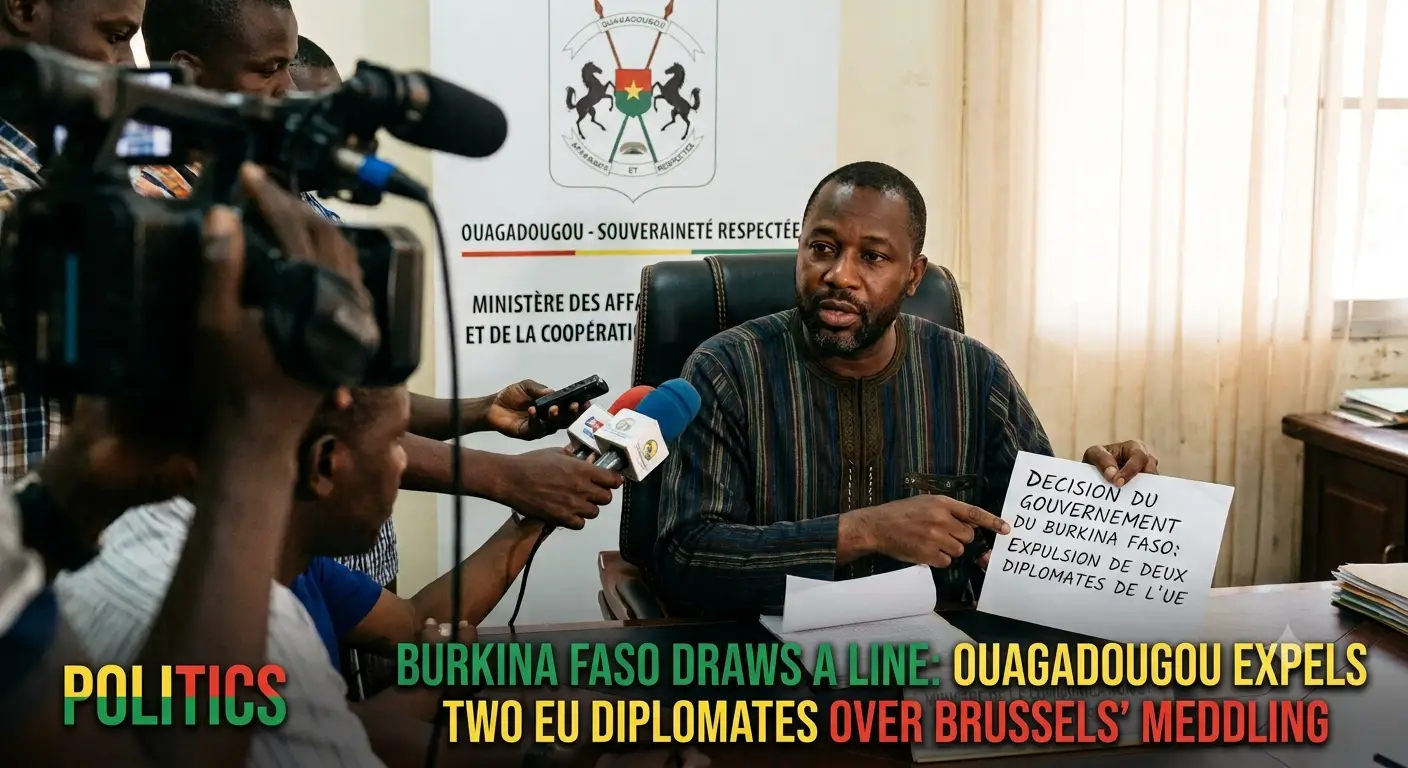
Burkina Faso EU diplomats expelled — that’s the blunt reality Ouagadougou delivered this week, giving two senior European Union officials just 72 hours to leave the country. In a decisive move announced this week, the transitional government declared two senior European Union officials persona non grata, giving them a mere 72 hours to pack up and leave the country.
The two diplomats affected are the Deputy Head of the EU Delegation in Ouagadougou — who also serves as head of the delegation’s political, press, and information section — and the official responsible for coordinating the EU’s programmes in the country. Burkinabè authorities have not spelled out an official justification for the expulsion, but nobody following the diplomatic back-and-forth of recent weeks needed one.
The real story began a few weeks earlier, when the European Parliament adopted a resolution accusing Ouagadougou’s military government of clamping down on civic space and fundamental freedoms. Burkina Faso’s leadership did not take the criticism lightly. Foreign Minister Karamoko Jean-Marie Traoré summoned the EU’s ambassador and head of delegation to the ministry to register his government’s anger in no uncertain terms. According to statements released at the time, the minister described the resolution as built on flawed information and accused European lawmakers of ignoring their own institutions’ role in regional instability — pointing specifically to NATO’s intervention in Libya as a root cause of the insecurity now spilling into the Sahel.
That earlier confrontation was meant to send a message. This week’s expulsion is the follow-through.
A Pattern, Not an Isolated Incident
For anyone tracking Burkina Faso’s foreign policy trajectory under the current transitional leadership, this expulsion fits a now-familiar rhythm. Ouagadougou has spent the past several months systematically distancing itself from what it considers patronizing Western oversight. Diplomatic ties with France were completely severed earlier this year, culminating in the full withdrawal of French diplomatic staff from the country. Even the United Nations has not been spared — last year, Burkina Faso expelled the UN’s resident coordinator after objecting to a report on children caught up in the country’s armed conflict.
Seen together, these episodes tell a consistent story: a government that has decided the era of quiet deference to former colonial powers and multilateral institutions is over, and that any perceived overreach — whether from Paris, Brussels, or New York — will be met with swift, visible consequences.
Sovereignty as the Central Argument
What Burkinabè officials keep returning to, in public statements and diplomatic protests alike, is the idea of sovereignty. Their argument is straightforward: a country fighting an active insurgency, one that has cost thousands of lives and displaced huge numbers of its own citizens, does not need foreign parliamentarians lecturing it on human rights from a distance. Officials have framed European criticism as tone-deaf at best and interference at worst — a continuation of the same paternalistic posture that many across the Sahel say has defined Western engagement with the region for decades.
This expulsion, then, is not just about two individual diplomats. It is a symbolic assertion that Burkina Faso intends to make its own decisions, on its own terms, without having to answer to institutions it did not elect and does not answer to. The government has repeatedly tied this stance to a broader push toward what it calls endogenous development — growth and governance shaped from within the country rather than imposed or guided from outside.
What Comes Next
The EU has not yet issued a detailed public response to the expulsions, though the bloc’s relationship with Ouagadougou was already strained well before this latest episode. Brussels now faces a familiar dilemma shared by several Western capitals operating in the Sahel: continue engaging with governments they publicly criticize, or risk losing what influence remains as juntas across the region draw closer to alternative partners.
For Burkina Faso’s part, the calculation appears simple. Captain Ibrahim Traoré’s government has staked its legitimacy on presenting itself as a break from the past — from foreign military bases, from aid dependency, and from diplomatic relationships perceived as unequal. Expelling two EU officials costs Ouagadougou relatively little in practical terms, but it sends a powerful signal domestically and across the region: this is a government willing to burn bridges with Europe if it believes its dignity is on the line.
Whether that approach strengthens Burkina Faso’s hand in the long run, or simply deepens its isolation at a moment when it desperately needs partners to help address a worsening security and humanitarian crisis, remains an open question. What is clear is that Ouagadougou has chosen confrontation over accommodation — and shows no sign of reversing course.