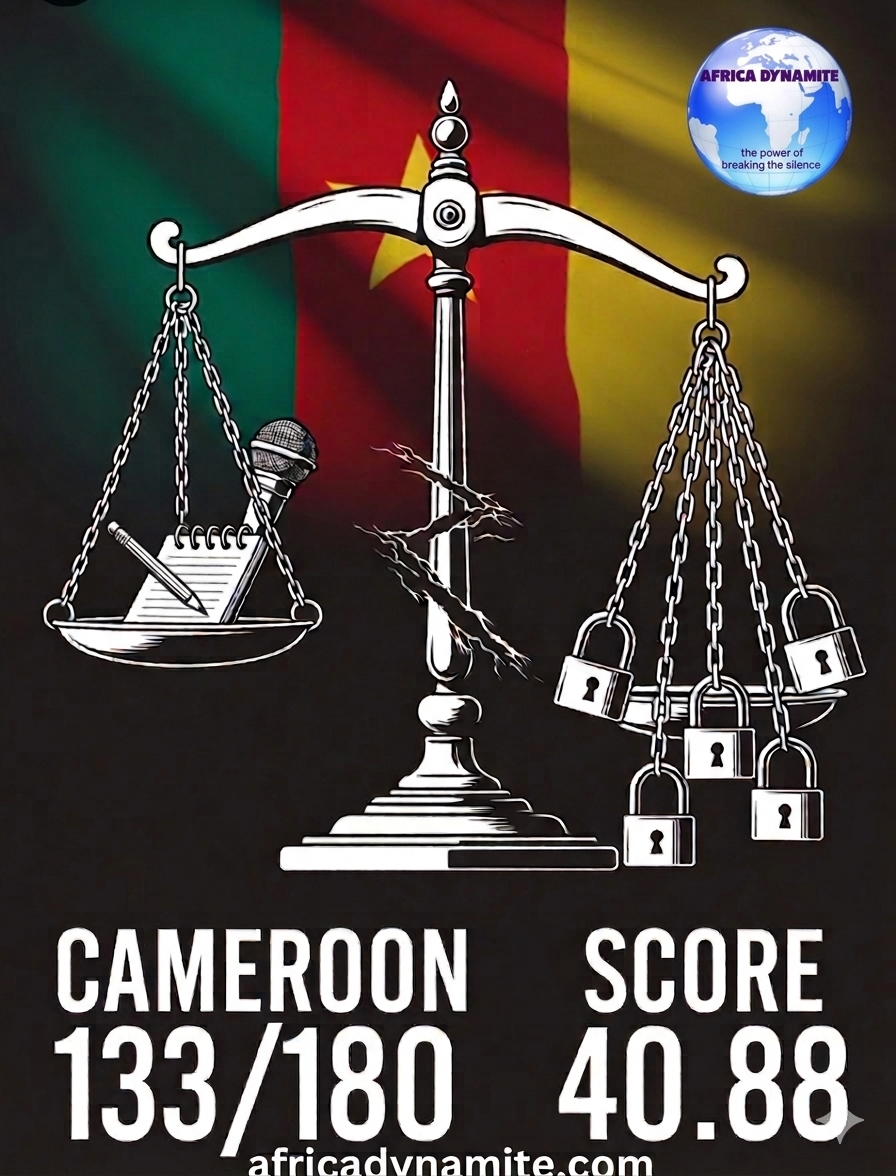
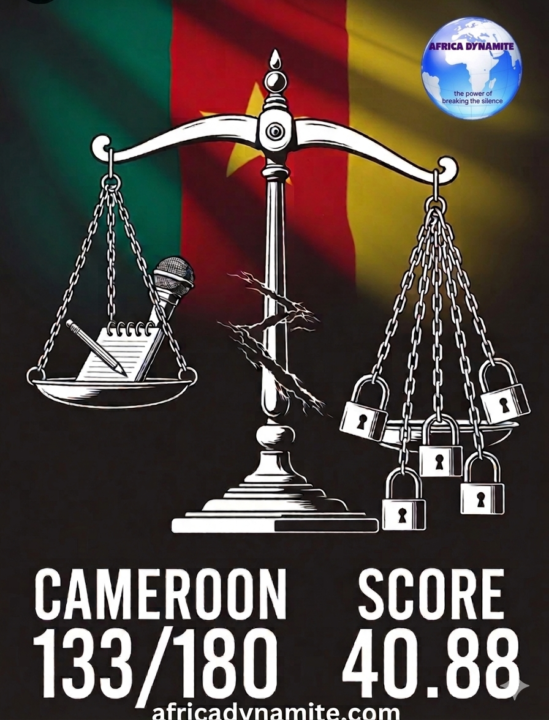
There is a figure I keep returning to: 40.88.
That is Cameroon’s score out of 100 on this year’s World Press Freedom Index, compiled and released by the international watchdog organisation Reporters Without Borders (RSF). It places the country at position 133 out of 180 nations and territories assessed globally. We are not hovering near the middle of the pack. We are deep in the lower third — far closer to the countries where journalism has effectively been extinguished than to those where it flourishes.
What makes this harder to dismiss is the wider context. The 2026 edition of the Index is not just another annual release — RSF has described it as the bleakest snapshot of global press conditions in the organisation’s quarter-century of tracking. For the first time, more than half of all countries assessed now fall into the categories of “difficult” or outright “very serious” for press freedom. The world is trending in the wrong direction, and Cameroon is moving with it.
The Numbers Game the Government Plays
Ask the Cameroonian government about its record on media freedom, and you will almost certainly be told about the country’s impressive media footprint — hundreds of newspapers, scores of television channels, and a radio landscape with more than two hundred stations. On paper, it sounds like a thriving press ecosystem. In reality, it functions more like a stage set: plenty of scenery, but not much going on behind it.
The sheer volume of outlets tells us very little about whether the people working inside them can pursue stories without putting themselves in danger. The legal environment that was supposed to protect journalists has instead been turned into an instrument of control. Press legislation that dates back to the 1990s is routinely bent to serve political purposes rather than the public interest. Journalists have no practical guarantee that their sources will be protected or that they can access official information without obstruction. They can be dragged before military tribunals and special courts — bodies that exist outside the ordinary judicial system and whose processes offer even fewer protections.
Quantity without safety is not press freedom. It is a performance of it.
The Human Cost
Statistics are easy to read past. The people behind them are harder to forget — at least they should be.
Martinez Zogo was a radio broadcaster who ran a programme that asked questions the powerful would rather not answer. In January 2023, he was abducted. His body was discovered five days later, bearing signs of severe violence. Years on, the full truth of who ordered his killing and why has not been established. Those responsible have not faced meaningful accountability. That pattern — violence followed by impunity — is one of the defining features of how journalists are treated in Cameroon.
Then there is the case of Amadou Vamoulké, who once headed Cameroon’s state broadcast service. He was eventually convicted on financial misappropriation charges that have been widely characterised as politically motivated — the product of two unfavourable rulings reached after a staggering 178 separate postponements. No country in the world has dragged a case out for that long before delivering a verdict. That alone should tell us something about the nature of justice in cases involving journalists who resist government pressure.
These are not isolated stories from a distant past. They are part of a recurring pattern that continues to define what it means to work as a journalist in this country.
The Situation in 2026
The harassment has not eased in the months since the new year began. In February 2026, a team of journalists — three of whom were working on behalf of a major international news agency — were picked up by security forces while reporting on a politically sensitive story involving migrants being quietly transferred to Cameroon from the United States. They were held for several hours, and their equipment — cameras, phones, laptops — was confiscated. A government spokesman offered no meaningful response when approached for comment.
This is not the behaviour of a government that is indifferent to the press. It is the behaviour of one that is actively hostile to it. Cameroon has spent years appearing on international watchlist after watchlist as one of the most dangerous places on the African continent to work as a journalist. The pattern of intimidation, detention and physical threat is consistent and well-documented.
A Global Crisis, With Local Consequences
In fairness, Cameroon is not unique in its direction of travel. A full hundred countries out of the 180 included in this year’s Index saw their press freedom scores decline. Global legal systems are increasingly being weaponised against reporters — not through outright censorship bans, which are too visible and draw too much criticism, but through counter-terrorism legislation, vague national security provisions, and anti-state charges that transform ordinary journalism into a criminal act.
Cameroon adopted this approach years ago. A sweeping anti-terrorism law passed in 2014, originally introduced in response to the threat posed by Boko Haram in the country’s north, has since been repurposed as a tool to silence journalists covering the Anglophone conflict in the country’s English-speaking regions. The law’s reach has been expanded far beyond its stated purpose, and reporters who pursue stories the government finds inconvenient now operate under the threat of terrorism charges.
This is the sophisticated modern approach to censorship: not burning newspapers, but making it professionally and personally ruinous to print anything that matters.
What That Score Really Means in Daily Life
does 133rd place actually look like for the people living inside it?
It means a journalist in Buea or Bamenda has to weigh whether a story is worth the risk to their safety before they decide whether it is worth pursuing. It means editors quietly drop coverage of certain topics not because they lack public importance but because publishing them could result in a suspension, a raid, or worse. It means whole communities — particularly those caught up in the Anglophone crisis — go substantially unreported or are filtered through a lens shaped more by political caution than by journalistic integrity.
A score of 40.88 is not a bureaucratic embarrassment. It represents a society in which the people tasked with holding power to account are themselves being held hostage by that power. And when journalism is suppressed, the effects ripple outward — corruption is emboldened, abuse goes unrecorded, and citizens are left making decisions based on incomplete or distorted information.
Closing Thought
I write about this because I believe naming a problem — clearly, publicly, without softening it — is itself an act of resistance. Norway has topped this Index for ten years running. That is not an accident of geography or culture. It reflects deliberate choices made at a societal level about the value of a free press and the protection it deserves.
Those choices are available to every government. They are available to Cameroon.
A score of 40.88 does not have to be the floor. But it will stay there — or sink lower — until the people who have the power to change things decide that truth-telling deserves protection rather than punishment.
That decision cannot come soon enough.