POLITICS & GOVERNANCE
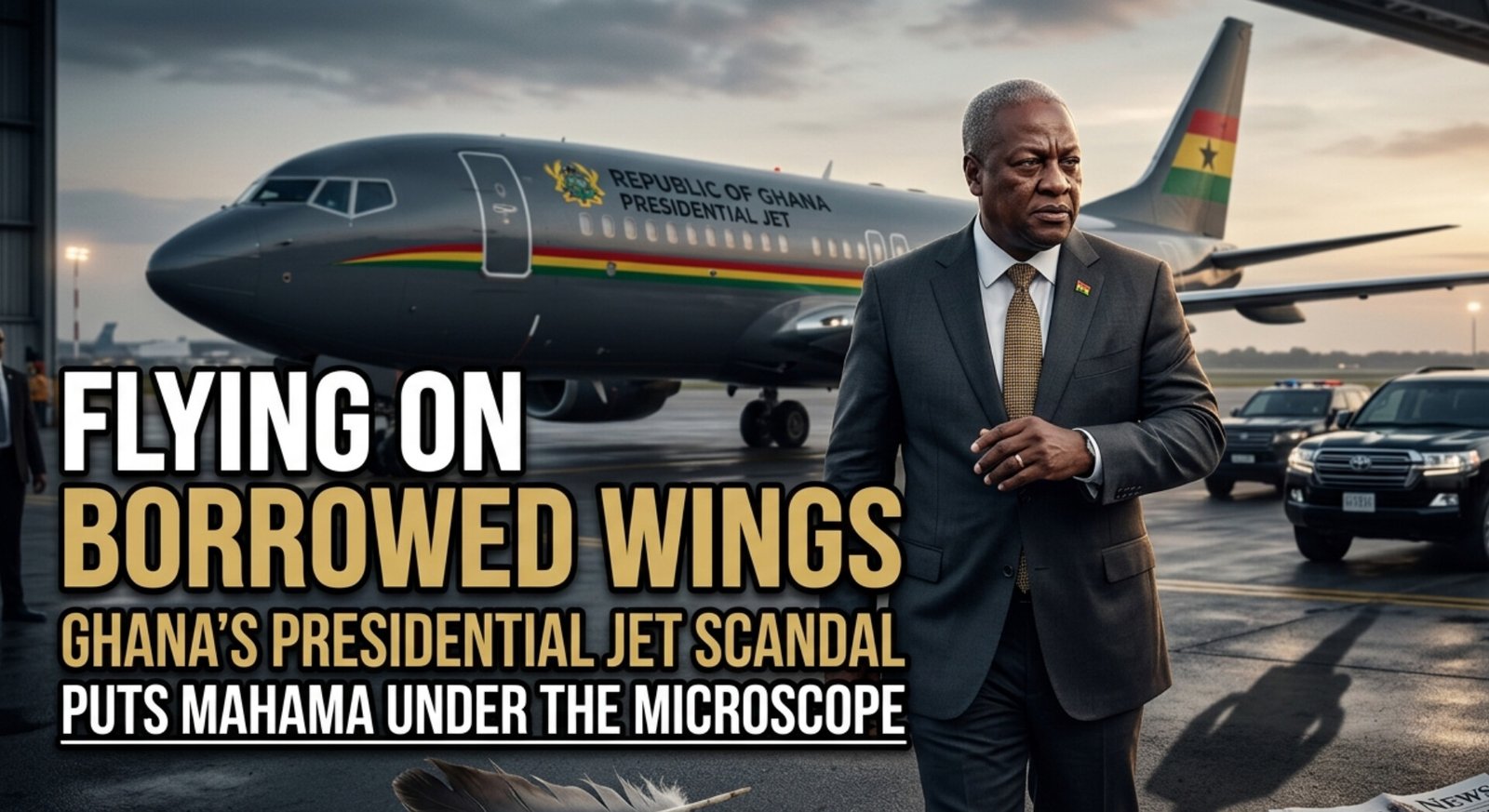
When Ghana’s official presidential aircraft became grounded by mechanical failures, President John Mahama turned to an unconventional solution — his brother’s private jet. Now, the decision is sparking a fierce national conversation about ethics, family loyalty, and the proper limits of public office.
There is a moment in every political career when personal relationships and public duties collide — and Ghana is watching one unfold in real time, 35,000 feet in the air.
President John Mahama has been using a private aircraft belonging to his brother, prominent businessman and mining magnate Ibrahim Mahama, for official state travel. The arrangement, which the presidency frames as a practical and cost-effective response to a maintenance crisis, has ignited a debate that cuts to the heart of how power, family, and public trust intersect in modern governance.
A Jet Grounded, a Brother Steps In
At the centre of the controversy is Ghana’s official presidential aircraft — a Falcon 900EX that entered state service during the presidency of John Kufuor. The jet has long been a reliable workhorse of Ghana’s diplomatic corps, but in recent months it has struggled with persistent mechanical problems serious enough to ground it during at least one official trip abroad.
After spending eight months undergoing repairs in Europe, the aircraft’s roadworthiness remains a subject of dispute. Faced with an unreliable state jet and the prohibitive cost of chartering commercial private flights for presidential travel, the Mahama administration settled on what it described as the most sensible option available.
Enter Ibrahim Mahama — the President’s brother, one of West Africa’s most recognisable business figures, and the owner of a private jet now ferrying the head of state to destinations including South Korea and Ethiopia. According to the presidency, Ghana pays only fuel and landing costs under the arrangement, sidestepping the far steeper fees that would accompany any commercial charter.
“Nothing Is Ever Truly Free”
Critics, however, are not persuaded by the arithmetic. The New Patriotic Party (NPP) has been the most vocal in raising red flags, with MP Abdul Kabiru Tiah Mahama among those leading the charge. Their argument is not simply about money — it is about perception, precedent, and the quiet but powerful influence that generosity can carry.
When a sitting president regularly accepts a multimillion-dollar asset from a private businessman — even one who shares his surname — opponents argue it creates an invisible but binding obligation. Future government contracts, regulatory decisions, and policy directions could all be shaped, consciously or not, by the weight of that debt.
The fact that the businessman is a family member does not simplify matters. If anything, it deepens the ethical fog. It is precisely the closeness of the relationship — and the history of dealings that inevitably comes with it — that makes the arrangement so difficult to evaluate from the outside.
A Pragmatic Fix or a Dangerous Precedent?
The presidency’s defenders see things differently. Ghana is navigating a period of fiscal pressure, and the optics of the government spending lavishly on luxury charter flights while citizens tighten their belts would carry its own political costs. If a vetted, safe aircraft is available at a fraction of the price, the argument goes, refusing it on principle alone amounts to performative austerity at the taxpayer’s expense.
What the debate ultimately exposes is a structural gap: Ghana’s official presidential fleet has not kept pace with the demands of an increasingly active head of state operating on a continental and global stage. The Falcon 900EX, whatever its storied history, may no longer be fit for purpose — and the government has yet to present a credible long-term plan to address that.
The Bigger Picture
Strip away the political theatre and what remains is a genuinely uncomfortable question about governance norms across the continent. How should African heads of state handle the inevitable overlap between their private lives and public responsibilities? And what standards should citizens demand when those two worlds blur?
For now, as President Mahama’s schedule continues to take him across the globe, the jet at his disposal remains his brother’s — and the questions trailing in its wake show no sign of being grounded anytime soon.